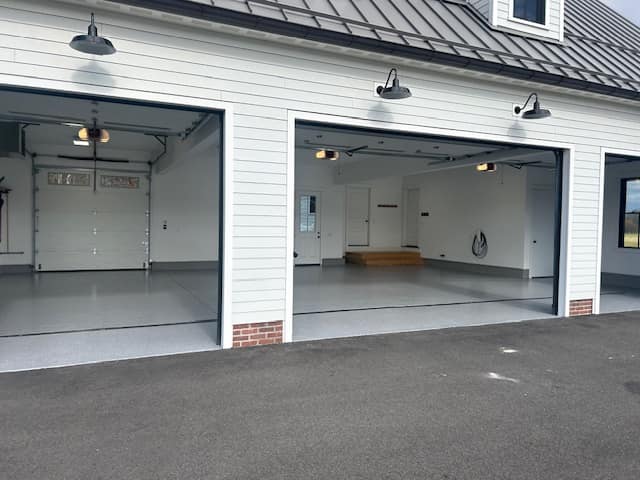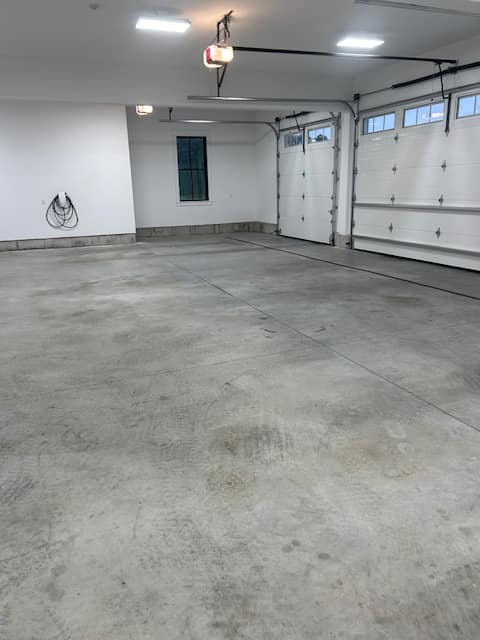
Massachusetts and Connecticut road crews spread hundreds of thousands of tons of salt and liquid brine every winter. It keeps the roads safe — and then it rides home on your car, drips onto your garage floor, and goes to work on the concrete.
If your slab is bare, every winter leaves it measurably worse: dusty white residue, rough patches, then pitting and flaking that never heals. Here's what's actually happening under your car — and why late summer and fall are the right time to do something about it.
How Salt Destroys Concrete
Concrete looks solid, but it's a hard sponge — full of microscopic pores that absorb water. Salt supercharges the two ways water kills concrete:
- Freeze-thaw pressure. Salty meltwater soaks into the slab, then freezes when the temperature drops overnight. Water expands about 9% when it freezes — inside the pores of your floor, that's like millions of tiny jacks prying the surface apart. The flaking this causes is called spalling.
- Chemical attack. Modern de-icers (magnesium chloride and calcium chloride brines) don't just melt ice — they chemically react with the paste that holds concrete together, softening the surface layer year after year.
The cruel part: the damage is invisible until it isn't. By the time you see pitting, the surface layer of the slab is already compromised.
Signs Your Floor Is Already Under Attack
- White, crusty residue that keeps coming back after you sweep (salt working out of the pores)
- Rough, sandy texture in the tire tracks and drip zones
- Small pits or "popcorn" flaking, especially near the garage door
- Fine cracks that widen a little every spring
Why Sealers and Mats Don't Cut It
Rubber containment mats catch some brine but trap moisture underneath and shift out of place. Consumer concrete sealers help briefly, but they wear off in the tire paths within a season or two — exactly where the salt lands. Protection that has to be reapplied every year isn't protection; it's a chore with a failure mode.
A professionally installed polyaspartic system is a dense, non-porous surface chemically bonded into the top of your slab. Salt brine can't soak in — it just puddles on the surface until you push it out the door with a squeegee. No absorption means no freeze-thaw jacking and no chemical attack. It's the same chemistry used on bridge decks, which live in road salt all winter. And unlike epoxy, it installs in any season and won't yellow or go brittle with age.
The Timing Math
Salt season in Western Mass and Northern Connecticut typically starts in November and runs through March. A floor coated in August, September, or October goes into winter sealed and comes out in April looking exactly the same. A floor you "get to in the spring" spends one more winter absorbing brine — and if spalling starts, you're paying for surface repair on top of the coating.
Most residential garages run $8–12 per square foot installed, including grinding and crack repair — full details in our Massachusetts cost guide. Fall scheduling is also simply easier to book than the spring rush.
The Bottom Line
Road salt is relentless, but it's only dangerous to concrete it can soak into. Seal the slab before the first storm and winter becomes a non-event for your garage floor. Want to see what a sealed, flake-finished floor would look like in your actual garage? Try the free AI floor visualizer — snap a photo, pick a blend, done in 20 seconds.
Pioneer Concrete Coatings installs garage, basement, and patio floors across Western Massachusetts and Northern Connecticut — including Springfield, Longmeadow, Agawam, Holyoke, Enfield, and Simsbury.
Beat the First Storm
Fall installation slots fill up fast. Get your free estimate now and go into winter with a salt-proof floor backed by a limited lifetime warranty.
Get Free QuoteRelated Articles
Can You Coat a Garage Floor in Winter?
Guide • 6 min read
Why Is My Epoxy Garage Floor Peeling?
Problems & Fixes • 7 min read
How Much Does Garage Floor Coating Cost?
Guide • 6 min read
Try It On Your Floor
Upload a photo of your garage and see it coated in seconds with our free AI visualizer.
Open the Visualizer