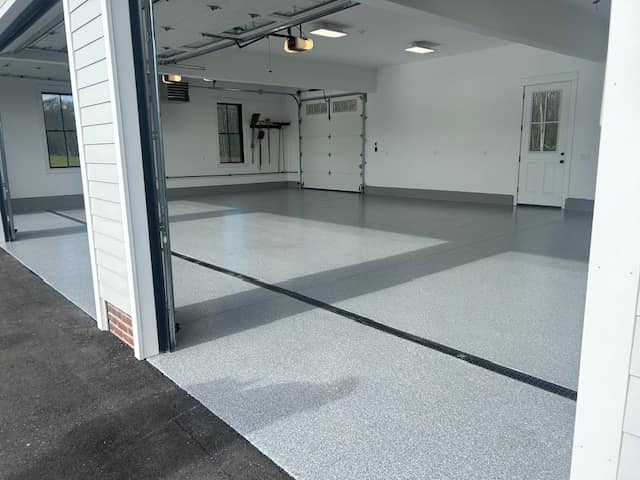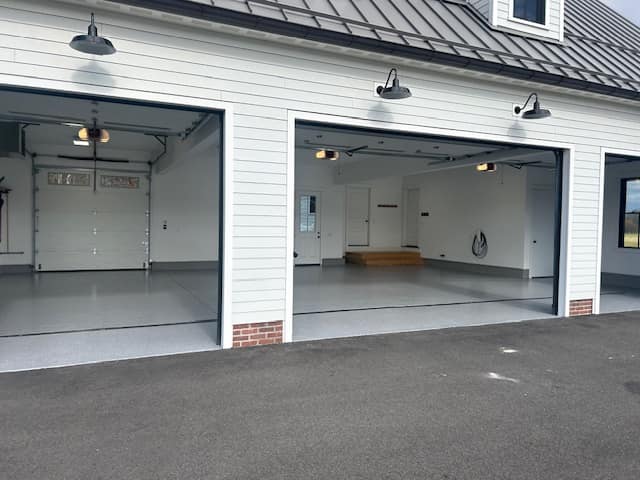
For years, "epoxy" was the buzzword for garage floors. But in recent years, a technology called polyaspartic has taken over the residential market. Originally designed for industrial applications like bridges and pipelines, this material offers significant advantages for your home.
Here are the top 5 reasons why we recommend polyaspartic coatings for garage floors in New England.
In warm weather, walk on it in about 24 hours and park after about 72 hours (longer in cool weather). Full cure typically takes about 7 days, or longer where the selected products or conditions require it. Follow the timeline provided for your floor.
Garage floors take a beating—from dropped tools and heavy vehicles to road salts and snowblowers. Polyaspartic coatings are significantly harder and more abrasion-resistant than epoxy. They are also slightly flexible, allowing them to handle the freeze-thaw cycles of Massachusetts winters without cracking as easily.
Have you ever seen an old epoxy floor that looks yellow or amber? That’s UV damage. Epoxy reacts with sunlight. Polyaspartic is aliphatic, meaning it is stable when exposed to UV light. Your floor will look just as clear and vibrant 10 years from now as it does today, even if you leave your garage doors open.
Gasoline, motor oil, brake fluid, and especially road salt (magnesium chloride) can wreak havoc on concrete and cheaper coatings. Polyaspartic creates a dense, non-porous seal that resists these chemicals. Spills simply sit on the surface waiting to be wiped up.
Cold weather doesn't have to mean waiting for spring, but temperature still matters. Our epoxy base coat and polyaspartic topcoat each have a minimum application temperature, and the slab needs to be at least 60°F during the install, or warmer if the selected products require it. In a warm garage, plan on staying off the floor for about 24 hours and parking after about 72 hours. In a cooler garage, allow more time, and we'll give you the timeline for your floor.
Conclusion
While polyaspartic coatings may have a slightly higher upfront cost than basic epoxy, the benefits in longevity, appearance, and convenience make them the clear winner for residential garage floors. You get a tougher floor, faster, that looks better for longer.
Pioneer Concrete Coatings installs garage, basement, and patio floors across Western Massachusetts and Northern Connecticut — including Springfield, Longmeadow, Agawam, Holyoke, Enfield, and Simsbury.
Upgrade Your Garage Today
Invest in a floor built to last. Contact Pioneer Concrete Coatings for a free consultation.
Get Free Quote